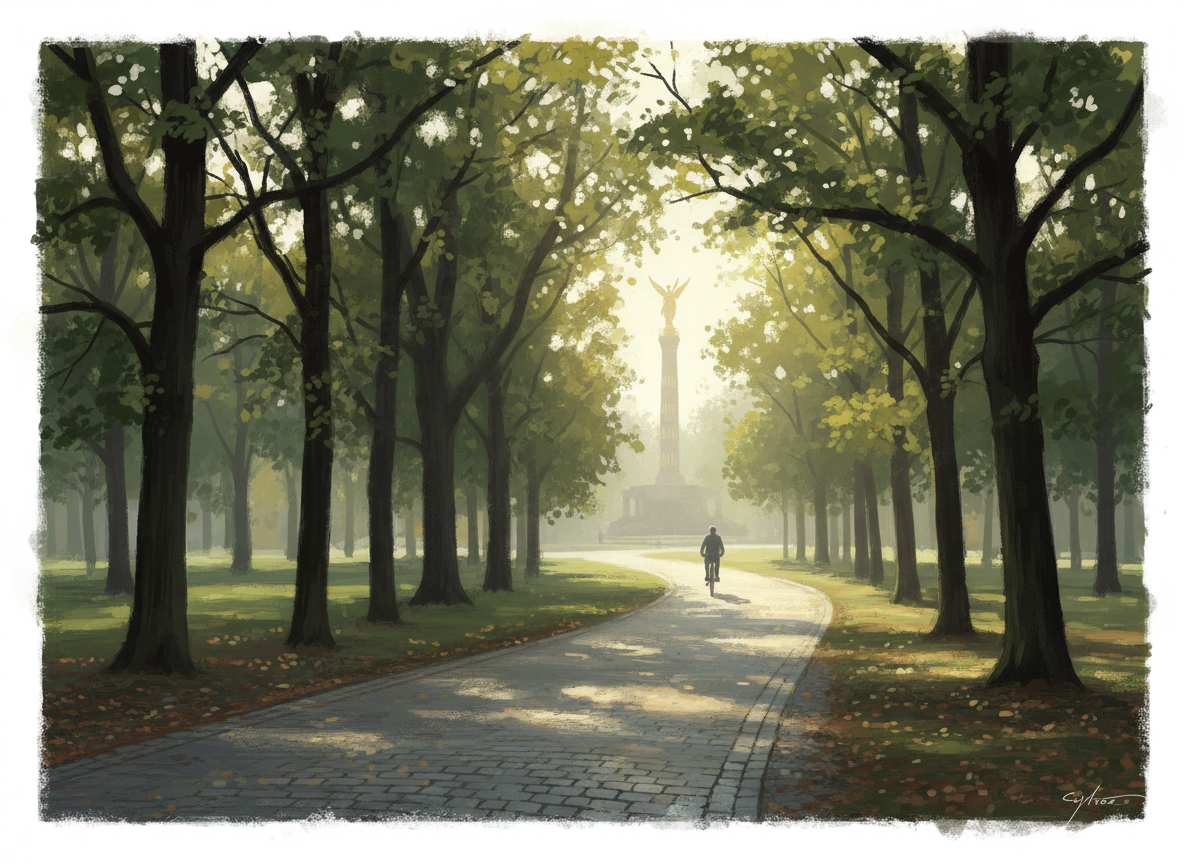
Most weekends I am on the bike before eight, when the city still feels half imaginary. The streets between home and the Tiergarten are all red lights blinking dutifully at nobody, bakery shutters just beginning to rattle, the occasional taxi sliding past like it has drifted in from another time zone. I roll through it without much of a plan, taking whatever left or right feels right, letting muscle memory and small curiosities decide the route. At that hour Berlin is generous: there is room to hesitate at junctions, to double back, to follow a side street simply because I have not ridden it in a while.

This morning I cut across the Tiergarten, entering near the zoo and slipping quickly into that soft, green anonymity the park does so well. Tourists tend to treat it as background, something that frames their photos of the Brandenburg Gate or the Reichstag, but rarely a destination in itself. It is too big, too apparently ordinary, and yet history keeps snagging on its fences. I pass the Siegessäule in the middle, absurd and golden, remembering that it was picked up and moved here by the Nazis, as if the city were a chessboard. Somewhere in the trees were the crowds of the Love Parade in the nineties, a million people and more pressing against the same paths that are now empty enough that I hear my tyres on the gravel. A few kilometres away in the Kleiner Tiergarten, a man was murdered in plain daylight not so long ago on the orders of another state. Layers on layers, and yet on this Saturday it is mostly joggers, a couple walking their dog, a gardener in high-vis.

This is the version of Berlin I love most, when it is scarcely performing for anyone, when for an hour or two it feels as though the whole place has forgotten to put its armour on.
Near the government buildings the trees fall away into the wide meadow they call the pilots, a flat green pause in the middle of the map. From here the city feels oddly provisional: glass ministries hovering at the edge, construction cranes paused like they are thinking, the river sliding past with its own private schedule. I stop there for a bad but welcome takeaway coffee, watching a lone runner trace the same circuit again and again as if she is trying to write something on the grass. This is the version of Berlin I love most, when it is scarcely performing for anyone, when for an hour or two it feels as though the whole place has forgotten to put its armour on. Cycling home, I am struck by how much these spaces hold without insisting on it: victories and parades, quiet crimes, ordinary mornings. Most of the time you only see the surface, but every turn of the pedals feels like a small act of reading between the lines.

| 1873 | The Siegessäule (Victory Column) is erected in front of the Reichstag, celebrating Prussian military victories over Denmark, Austria and France. |
| 1939 | The Nazis relocate the Siegessäule to its current position in the centre of the Tiergarten, adding a fourth drum to make it taller. |
| 1989–2006 | The Love Parade brings millions of ravers to the Tiergarten each summer, turning the park into one of the world’s great open-air dancefloors. |
| 2008 | Barack Obama speaks to 200,000 people at the Siegessäule during his presidential campaign — one of the largest political crowds in Berlin’s post-war history. |
| 2019 | Zelimkhan Khangoshvili, a Georgian-Chechen dissident, is shot dead in the Kleiner Tiergarten by a Russian agent. The killer is convicted in 2021; Germany expels two Russian diplomats. |